
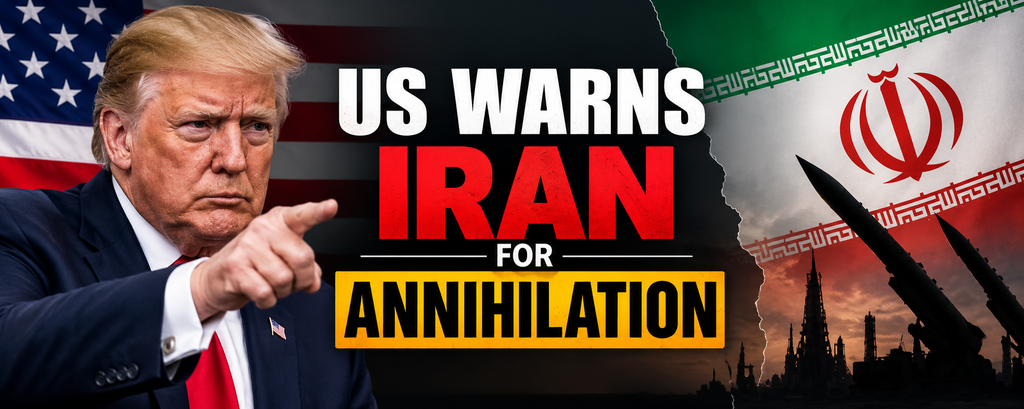
On September 22, 2026, while speaking at the 81st session of
the U N General Assembly, U.S. President Donald Trump threatens Iran with extreme military action. Tensions between the United States and Iran have raised concerns
about peace and stability in West Asia. The dispute is also affecting global
security and energy supply, especially in the Middle East. At the same time,
Trump suggested that there could still be a chance for diplomacy and negotiations
after the completion of U.S. midterm elections. These mixed signals show how
difficult it has become to find a lasting solution to the crisis.
US Interests in Iran
Security of Nuclear Programme: The US aims to prevent
Iran from developing nuclear weapons to maintain global peace and supports
supervision and monitoring to address nuclear concerns.
Regional Security: Iran holds significant influence
across West Asia. The US is concerned about Iran’s role in adverse regional
conflicts and its ties to armed groups.
Protection of Its Allies: The US seeks to safeguard
allies—such as Israel and Gulf nations—from security challenges linked to
regional tensions in the Middle East.
Energy Security in the Middle East: The “Strait of
Hormuz” is a vital route for global energy trade. Stability in this Middle East
region is crucial for international markets.
Strategic Influence: The US aims to limit Iran’s
strategic influence while keeping the door open for diplomatic dialogue.
Avoiding War: Washington is also concerned about a
prolonged regional conflict in West Asia, which could impact global security
and the economy.
Why Has Trump Threatened Iran ?
Relations between Washington and Tehran have been highly
tense due to US sanctions imposed over Iran’s present nuclear program. The
ongoing conflict has persisted for several months and has adversely affected
the energy markets through the potential closure of the Strait of Hormuz.
Trump has criticised Iran’s nuclear program as non-peaceful—implying a
need for potential US military action—whereas Iran states that its nuclear
activities are peaceful.
What did Trump say?
In his address to the United Nations, Trump presented Iran
with a choice: either reach an agreement or face further US military action. He
stated that if a decisive agreement is not reached, his administration might
decide to “destroy” the Islamic Republic. He also called upon all
nations to economically isolate Iran. However, Trump also expressed some hope
that if an agreement could be reached through any fruitful dialogue, then he
would consider that option first.
Why is this statement significant?
1. Risk of escalating tensions
•Severe military threats could heighten uncertainty and
tension across West Asia.
•Rising tensions could adversely affect neighboring
countries, shipping routes, and regional stability.
•This could also complicate diplomatic efforts to resolve
the conflict.
2. Impact on global energy security
•Iran is strategically important to the global energy market
due to its proximity to the Strait of Hormuz—a vital route for international
oil shipments; any military threat could negatively impact global energy
markets.
•The recent address has already raised concerns regarding
energy supplies.
•Reports indicate that oil prices rose following Trump’s
recent comments, a trend that could sustain long-term instability.
3. Diplomatic challenge
•This statement highlights a significant imbalance between
coercive diplomacy and dialogue.
•The US is demanding an agreement while simultaneously
maintaining continuous military pressure.
•Iran has signaled that it might consider diplomatic talks
and a resolution if US military pressure is eased.
Implications for India
•India has significant economic and strategic interests in
West Asia.
•This region is significant for the following reasons:
- India’s crude oil imports
- Energy security
- Trade and shipping
- Indians residing in Gulf countries
- Connectivity projects
•If instability persists for a prolonged period and energy
prices remain high, India’s import costs could rise. Disruptions to major
shipping routes could also lead to increased transport and insurance costs.
Therefore, India has a vested interest in dialogue and a diplomatic resolution
between the two nations.
Role of the United Nations
The UN remains a crucial platform for dialogue, even amidst
disagreements between nations. The UN General Assembly brings together 193
member states, providing a forum for international discussion and conflict
resolution. Consequently, the Iran crisis tests the capacity of international
institutions to foster dialogue and prevent further escalation of tensions. It
remains to be seen how effective diplomacy, mediation, and international law
will prove in managing the confrontation.
Way Forward
Resuming diplomatic dialogue between the US and Iran to
reach a decisive agreement. Utilizing third-party mediation—such as that
of the UN—in situations where direct talks are difficult. Ensuring the
security of international shipping and energy routes to maintain a smooth flow
of energy.

About the Author: Deepak Srivastava
An author of World Affairs, International Relations, Global Politics, Public Policy and Current Events.
1 Comment