
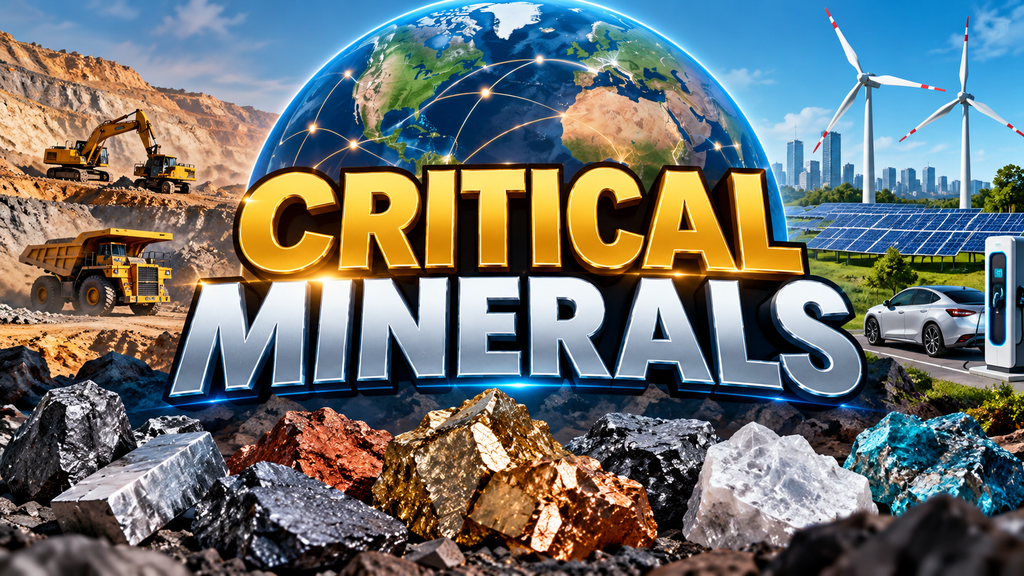
Critical minerals are the backbone of many products from smartphones and laptops to electric cars and power plants. They are required in modern technologies and contribute to the development of various industries, such as health care, communications, energy, and manufacturing. Apart from this, although critical minerals are not something most people think about regularly, they still have great significance for the economy and security of a country.
A mineral is defined as critical when its existence is vital for the economy or national security and its supply chain might be interrupted. The risks increase when the processing or mining of a mineral depends on a limited number of nations. Because of this, many countries are striving to ensure more reliable sources of critical mineral resources. Knowing the types of critical minerals, their uses and availability can help to understand why this is an important problem nowadays.
1. What Are Critical Minerals and Why Are They Called Critical?
What are Critical Minerals?
These materials are those which are necessary for the economy or national security of a country but may be hard to acquire in reliable ways. In the United States, there is a certain legal definition provided by the Energy Act of 2020. First, the mineral should be vital for the economy or national security of the nation. Also, it has to perform an important role in the manufacturing and its supply chain has to be potentially vulnerable. Thus, being critical does not mean rarity of the mineral, as a very common element may be called critical when its production and processing processes depend on the few locations. Assessing the supply chain and updating the list is the responsibility of the U.S. Geological Survey (USGS).
Why are they called critical?
The importance of minerals for an economy is determined by two aspects – their economic value and vulnerability of the supply. For instance, one may imagine a factory which requires only a little amount of a certain mineral to make computer chips. The lack of it can lead to the delays, even though all the rest supplies remain abundant.
Another point is that some minerals appear to be the by-product of other mining operations, and their production cannot be increased easily. The mineral security is provided through reliable access to domestic production, diversification of imports, recycling, and processing capability. In the United States, the list of critical minerals is a tool which allows understanding the supply chain risks of certain materials and not ranking them according to the economic value or scarcity.
Critical Minerals and Rare Earth Elements
Rare earth elements are a special group of 17 elements, which are chemically similar to each other. These materials are used in selected magnets, electronics, and other technologically advanced products. However, rare earth elements are just one group out of many critical minerals, such as lithium, copper, graphite, nickel, and others. In other words, not every rare earth element is critical in every country, and not every critical mineral is a rare earth element.
2. What Are the Different Types of Critical Minerals ? Complete List
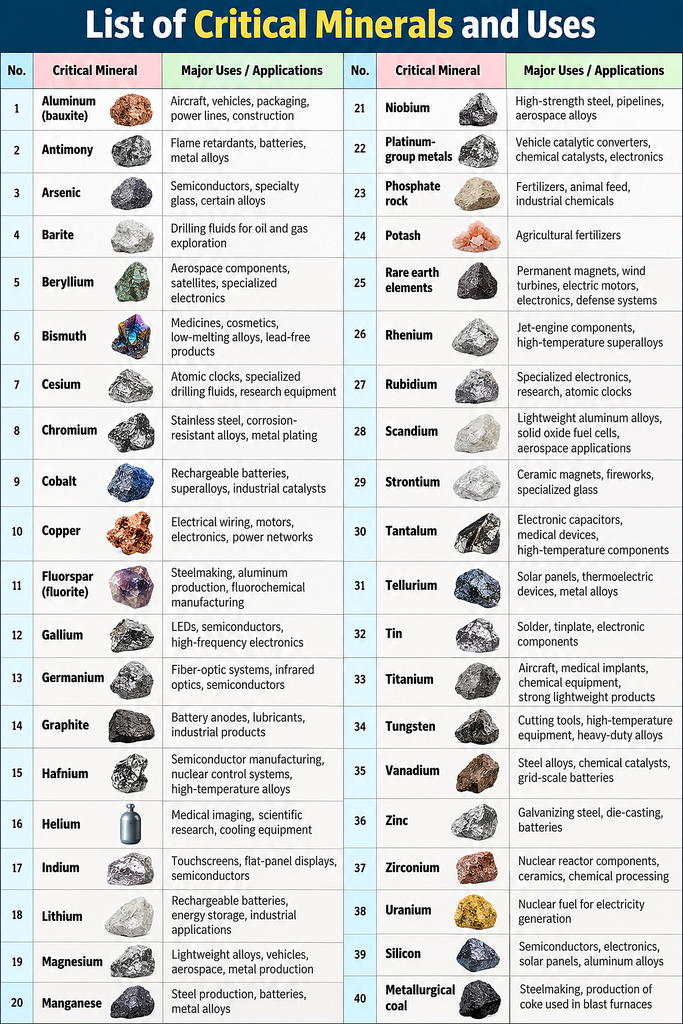
The classification of critical minerals in United States is based on the economic and security interests of the country. The 2025 USGS list includes 60 minerals and mineral commodities.
How Critical Minerals are Grouped
These materials may be classified according to their major uses. Battery minerals include lithium, graphite, nickel, cobalt, and manganese; however, not every battery requires all of these minerals. Technology minerals are gallium, germanium, indium, and silicon. Copper, aluminum, chromium, and zinc are the minerals used in construction, transport, and manufacturing. All these groups overlap, since the single mineral may be used in several industries.
3. What Are the Major Uses and Applications of Critical Minerals?
The usage of critical minerals goes beyond mining and heavy industry. They are used for manufacturing electric cars, wind turbines, solar panels, computers, medical devices, and aircraft. For instance, copper is conducting electricity in power systems, while lithium and graphite are important in manufacturing of batteries. Some rare earth elements are used for producing magnets for selected motors and generators.
Silicon is the material, which is used to make conventional semiconductor chips and solar cells. Thus, these critical minerals applications demonstrate why today’s products depend on materials produced in several countries and processed in several stages.The materials are also useful for some other industries which are not associated with mining initially. Minerals used in medical devices can be found in selected imaging systems, electronic equipment, and alloys.
Space technology minerals may be used in satellites, sensors, and high-performance components. Some defense minerals include titanium, tungsten, cobalt, and others to satisfy certain aerospace and industrial functions. These examples do not mean that any device has all these minerals. Manufacturers select appropriate minerals according to the design, performance, cost, and safety requirements of the product.
Critical minerals in clean energy and transportation
A battery car requires some minerals, such as lithium, graphite, nickel, cobalt, and manganese depending on its battery chemistry. Copper conveys the current through the motors, wiring, and charging system. Certain electric motors require rare earth magnets, while other designs do not require them. The role of minerals used in renewable energy is also different – copper for electrical network, silicon for solar panels, and some rare earth elements for manufacturing magnets for wind turbines. The mix of the mineral is changing along with the technology, so demand forecasts should consider this.
Critical Minerals in electronics and industry
Materials used in semiconductor manufacturing include silicon and other special materials, such as gallium, germanium, and indium. Their properties allow manufacturers creating chips, sensors, displays, and communication equipment. Steels also depend on the minerals, which are used during its production. Metallurgical coal may be turned into coke, while chromium, manganese, nickel, and other elements are used for production of steels. These materials are used for constructing buildings, transport systems, machines, and industrial equipment.
4. Where Are Critical Minerals Found Around the World?
Which countries produce critical minerals? Australia, Chile, and China are the biggest producers of lithium, while the Democratic Republic of the Congo is the source of mined cobalt. Nickel is mostly produced in Indonesia. Chile and Peru are the big copper producers, while China is the source of graphite and rare earth elements. These examples demonstrate how uneven are critical mineral reserves and production across the globe. Rankings of mining countries can change due to new projects, enlarging of mines, or price changes.
Mining is just a part of the critical mineral supply chain. After being extracted from the ground, the ore has to be crushed, separated, processed chemically, and refined to turn into the form used by manufacturers. Which countries are dominating in the refinement and processing of critical minerals? China is the big processor of many energy-related minerals, while Indonesia is expanding its processing of nickel. According to the International Energy Agency, the refinement of critical minerals remains extremely centralized. Such centralization raises the risks, since the disruption of the one major processing center affects all the manufacturers.
Critical Minerals availability in the United States
The United States has domestic mineral resources and active production, but the situation with minerals is different for different materials. A country can produce a mineral but still import the products or refined materials for its industries. The USGS analyzes the production, consumption, trade, and import reliance to understand these issues. Its 2026 Mineral Commodity Summaries report gives the updated statistics on U.S. mineral production, including the information on trade and supply.
5. Why Is the Demand for Critical Minerals Increasing?
The increasing demand for the critical minerals takes place due to the development of such industries as electrification, digital systems, and advanced manufacturing. For instance, production of electric cars and energy storage requires battery materials, while the power grid requires large amounts of conductive metals. Both wind and solar energy require minerals in generators, wires, electronics, and infrastructure. The transition is not dependent on the single mineral.
Instead, it increases the demand for the variety of materials whose roles are different according to the technology and design. The demand trends are tracked by the International Energy Agency in several possible energy and technological scenarios. The digital technology is the other factor that increases the demand for the critical minerals. The data centers, communication networks, and advanced computing require chips, power equipment, cooling systems, and reliable power supply.
Minerals used for advanced batteries also become more significant as businesses and households try to find ways to store energy. In addition to it, aerospace, health care, construction, and defense continue to use special metals and minerals. These broader demands can result in the competition between industries and may increase the need in reliable supply of a mineral due to its lack of practical substitutes.
Why demand does not always mean shortages
Increasing demand does not necessarily result in shortages. Rising prices may encourage the new mining projects, refinement facilities, recycling projects, and research of substitutes. However, all these actions take time. The mineral project requires exploration, investments, permits, infrastructure, and skilled workers. For this reason, the market may experience shortage in supplies before the production becomes active. The forecast of demand depends on the technology choice, policies, economic growth, and consumer behavior.
6. What Are the Major Challenges in the Critical Minerals Supply Chain?
First, it is the geographic concentration. When the few countries produce or refine the majority of the mineral, any restrictions, conflict, transport problems, or shutdowns of the processing facilities can affect the global buyers. The other problems include long project timelines, expensive investments, insufficient processing capacity, volatile prices, and environmental concerns.
Some materials also are considered by-products of other mining activities, making the supply less flexible to the changes in demand. The IEA warned that centralized production and refinement of critical minerals can leave the market vulnerable even if the supply seems to be enough.
The environmental and social concerns can also influence the critical minerals development. The mining and processing consume the land, water, energy, and chemicals. The projects should take care of the waste and protection of surrounding communities and ecosystems. The recycling reduces the need for new mining, but it cannot substitute the mineral production immediately. Many products have long lifetime before they can be recovered for reuse. Thus, the diversified mineral supply requires many actions simultaneously: the responsible mineral production in the country, reliable trade partners, better processing, recycling, and substitutes research.
What happens when supply chains are disrupted?
The disruptions cause the rising prices, delays in manufacturing, and necessity to find new suppliers. For instance, the battery manufacturer may have to qualify a new source before using its mineral. The process takes time because the material has to meet some technical and quality requirements. The supply security is not just the minerals available underground. It also requires the ability to convert the material into the proper product and deliver it to the manufacturer.
7. What Is the Critical Minerals Value Chain?
The critical minerals value chain describes the way from the discovery of a deposit to the recycling of used products for further use. The first stage includes the geological survey and exploration, while mining extracts the ore. Then it is processed and refined, while manufacturers transform the mineral into various components, such as battery materials, magnets, alloys, and electronic parts. Finally, recycling recovers the useful minerals from the used batteries, electronic devices, industrial waste, and other products. What are the five stages of the critical minerals value chain? These are exploration, extraction, processing and refining, component manufacturing, and material recovery. Every stage is important as the lack of development in one of them may limit the entire value chain.
The country with mineral deposits may still import the mineral if it lacks the facilities of processing and component manufacturing. For this reason, the mineral strategy includes not only new mines but also skilled workers, research, reliable infrastructure, environmental safeguards, and businesses able to process the materials in large scales. The recycling process strengthens the chain by providing the recycled materials back to the production. Yet, this step depends on the systems of collecting, product design, and the cost of materials separation. The diversified supply chain has to include several sources instead of just one mine or supplier.
8. What Is United States Position in Critical Minerals ?
United States treats the mineral supply chain as the economic and security issue. In its 2025 report, the USGS prepared the list of 60 critical minerals and commodities after evaluating the supply chain risks and their economic impacts. The list includes materials used in energy, aerospace, electronics, construction, and other sectors. The list is not a list of the world’s rarest minerals. Instead, it is the materials with the disruption potentially affecting the country.
The country has domestic mines, research institutions, manufacturers, and recycling projects. However, the import reliance of the United States depends on the mineral and processing stage. In its 2026 report, the USGS stated that the country is still highly dependent on the mineral imports from China, being the major source of 14 of 33 critical minerals on which the United States most relies on. This demonstrates why the mineral resource security in United States requires both domestic capacity and diversified international supply. It does not mean that the country imports all critical minerals or lack domestic resources.
Why are critical minerals important for United States?
They are used for manufacturing energy equipment, communication systems, transportation technology, medical devices, and defense-related products. The shortage in these materials can affect the manufacturing schedules and raise the costs.
What role do critical minerals play in national security?
They are used for providing access to the materials for selected defense and industrial systems. However, the national security depends on many factors, including manufacturing capacity, skills of the workforce, infrastructure, and trusted suppliers.
How can the United States reduce mineral import dependence?
The United States can reduce the mineral import dependence through the expansion of the responsible domestic production, better processing capacity, recycling, and relationship with multiple suppliers. It can encourage the research of the substitutes and more efficient material usage. The complete independence from the mineral import is difficult for many minerals due to the different geology, costs, and technical abilities of the country. The more realistic goal is the reliable and diversified supply chain.
9. What Are the Government Initiatives for Critical Minerals in United States?
The U.S. government uses the research, mineral assessments, grants, and industrial programs to ensure the supply chain resilience. The USGS maintains the list of critical minerals and provides the information about mineral production, consumption, and supply risks. The Department of Energy also supports the mineral processing, battery manufacturing, recycling, and development of new recovery technologies.
In August 2026, the DOE announced the $500 million grant for seven selected projects aimed at increasing the critical mineral processing, battery manufacturing, and recycling capabilities in the United States. These projects are the part of a wider program. The federal initiatives include the research of minerals recovery from industrial waste and better utilization of existing resources. The Department of the Interior mentioned efforts to recover minerals from the mine waste, coal refuse, tailings, and abandoned mine sites.
Such approach can provide additional materials, although the recovery depends on the mineral content, technologies, costs, and environmental conditions of each site. While the government support helps to implement the research into commercial applications, announcements about funding do not necessarily mean success of every project.
10. What Is the Future of Critical Minerals ?
The future of the mineral demand will depend on the energy systems, manufacturing, technology, and global trade. The electric vehicles, renewable energy, digital infrastructure, and advanced industry may increase the demand for the selected minerals. On the other hand, the technology progress may help to decrease the amount of a mineral used in the product or choose alternative minerals. The International Energy Agency’s outlooks assess multiple scenarios of future demand and supply but do not predict one specific path. Projections can help in planning but final results will depend on investments, policies, price developments, and innovations.
The United States and other countries will strive to achieve supply diversity, process capabilities and material recovery. Recycling of critical minerals can help reduce waste and augment primary supply while innovations may contribute to better extraction and refinement of materials. At the same time, recycling cannot fully satisfy future demand due to long life cycle of products and difficulty of recovering some minerals. Long-term perspective consists not in mining more. It consists in establishing reliable system combining responsible production, efficient usage, innovations and material recovery.
Conclusion: Why Critical Minerals will remain important?
Critical minerals combine technologies, manufacturing, energy, and national security. Not only their unique properties make them important, but the risks associated with their supply. Resilient strategy of the United States implies that it should know which minerals are critical, which sources are available and how supply chains can be interrupted. Enhanced domestic capabilities, supply diversification, recycling, and research can help in mitigating the risks. The key challenge remains the same: secure supply and develop minerals responsibly.
FAQs Critical Minerals
1. What are critical minerals?
Critical minerals are natural resources that are essential for modern industries, clean energy, defence, electronics and advanced technologies. Their importance increases when supply is limited or vulnerable to disruption.
2. Why are critical minerals important for the modern economy?
Critical minerals support products such as electric vehicles, batteries, smartphones, semiconductors, renewable energy equipment and defence technologies. Their availability directly affects industrial development and technological progress.
3. Which minerals are considered critical?
The list varies from country to country. Common examples include lithium, cobalt, nickel, graphite, rare earth elements and certain minerals used in advanced manufacturing and clean-energy technologies.
4. Why are critical minerals becoming a geopolitical issue?
Critical minerals are increasingly linked with economic security and national power. Countries want reliable supplies because disruptions can affect industries, technology production and strategic capabilities.
5. Why is China important in the critical minerals supply chain?
China has a major role in several stages of critical mineral supply chains, including processing and manufacturing. This has encouraged other countries to diversify their sources and strengthen domestic capabilities.
6. Why does the United States focus on critical minerals?
The United States views reliable mineral supply chains as important for economic and national security. It has therefore encouraged domestic production, recycling and partnerships with other countries.
7. Why are critical minerals important for India?
India needs critical minerals for electric mobility, renewable energy, electronics, defence and high-technology manufacturing. Secure supplies can support India’s industrial and strategic ambitions.
8. What is the connection between critical minerals and electric vehicles?
Electric vehicles require minerals such as lithium, nickel, cobalt and graphite for batteries. Growing EV adoption is therefore increasing demand for secure and diversified mineral supply chains.
9. How are critical minerals connected to renewable energy?
Solar panels, wind turbines, batteries and electricity networks use various minerals and metals. A reliable supply of these resources is important for expanding clean-energy infrastructure.
10. Why is mineral processing as important as mining?
Mining alone does not guarantee supply security. Minerals often need refining and processing before they can be used in advanced industries. Processing capacity can therefore become a strategic advantage.
11. What are the risks of depending on a few countries?
Heavy dependence on a small number of suppliers can create vulnerability to export restrictions, geopolitical tensions, natural disasters or market disruptions. Diversification helps reduce these risks.
12. Can recycling reduce dependence on critical mineral imports?
Yes. Recycling can recover valuable minerals from batteries, electronics and industrial products. It can reduce pressure on new mining and create an additional source of supply.
13. What is the environmental challenge associated with critical minerals?
Mining and processing can

About the Author: Deepak Srivastava
An author of World Affairs, International Relations, Global Politics, Public Policy and Current Events.