
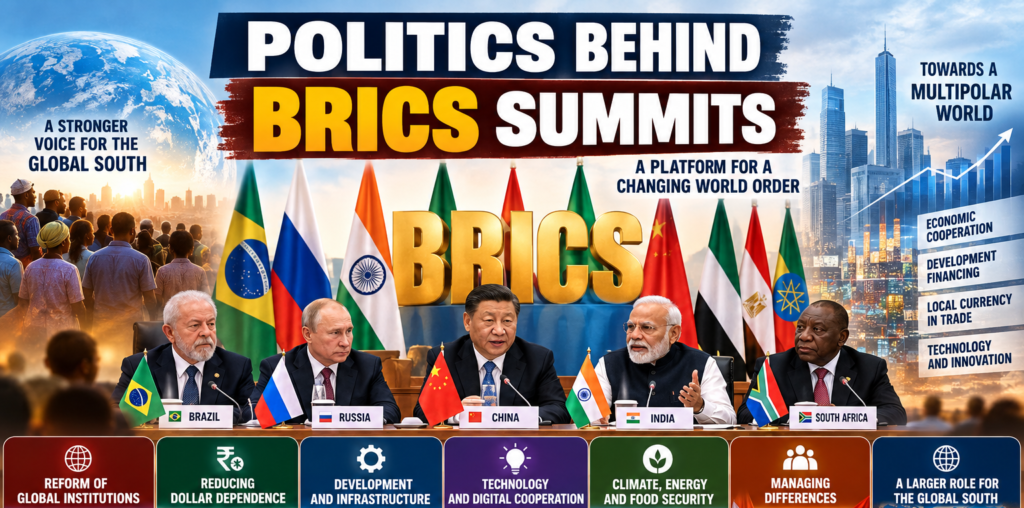
At the core of the politics behind BRICS is concern about the unfair concentration of power in the hands of one country – The United States. The dominance of the American dollar in international trade and finance gives the United States disproportionate leverage over the world economy. Several BRICS members have therefore been in favour of promoting the use of local currencies, alternative payments and enhanced financial cooperation – not necessarily to abandon the dollar altogether, but to reduce over-reliance on a single monetary system.
BRICS also seeks a more equitable representation of emerging economies in institutions such as the IMF, World Bank and UN Security Council, which were dominated by established powers at the time of their foundation. Members of BRICS have different foreign-policy interests and continue to pursue economic and diplomatic ties with Western countries.
BRICS has become an important platform for major emerging economies to increase their role in the world economy and international politics. Starting as cooperation between Brazil, Russia, India and China, followed by South Africa, it has gradually evolved into a forum for discussing trade, development, finance, technology, energy and global governance.
The Question of De-dollarisation
One of the most controversial topics in the context of BRICS is the role of the US dollar in international trade and finance. Some members of BRICS have promoted the use of local currencies, alternative payment systems and enhanced financial cooperation to reduce the dominance of the American dollar. The rationale behind this approach is that excessive reliance on one currency can expose developing countries to financial and economic risks.
However, de-dollarisation is a complex process that requires time and effort. The dollar has entrenched itself in the global financial system, which means that alternatives will have to compete with it for influence. Ultimately, the goal of BRICS is to expand financial opportunities and reduce the risks associated with a single currency, but it is unlikely to replace the dollar as the world’s dominant currency.
BRICS and the Idea of Multipolarity
One of the key ideas behind BRICS is multipolarity – a world in which international power is distributed among several major powers rather than concentrated in the hands of one country or group of countries. Russia and China have been strong proponents of multipolarity, while other members of BRICS also seek a more balanced international system.
However, there are differences between the approaches of individual countries. In particular, India has strategic partnerships with the United States, Europe, Russia, Japan and the Global South and therefore focuses on strategic autonomy rather than an explicitly anti-Western alliance. This nuance is crucial to understanding the politics behind BRICS. The grouping provides countries with an opportunity to raise their voices on the international stage and pursue their strategic interests, but they retain their economic and diplomatic independence.
BRICS and International Institutions
Reforms of international institutions is another important topic in the politics of BRICS. Members of the grouping have promoted the need for a more equitable global system in which developing countries have greater representation and resources. The composition of the UN Security Council, for example, reflects the outcome of the Second World War, rather than the current realities of the international system.
However, achieving this goal will require sustained diplomatic efforts, as will other institutional reforms. Thus, BRICS can enhance the political influence of emerging economies, but its effectiveness will depend on the degree of commitment of all parties involved.
BRICS and the United States
BRICS countries have increasingly called for greater representation of emerging economies in global institutions and, in some cases, greater use of national currencies in trade. These positions have attracted attention in Washington because they could gradually reduce dependence on the existing dollar-centred financial system.
However, BRICS is not a formal anti-American alliance. Its members have different political interests and maintain varied relationships with the United States. India, for example, participates in BRICS while also developing strategic partnerships with the United States and other Western countries. The United States has stated that countries are free to choose their international partnerships and has focused on strengthening its own global coalitions.
Therefore, the politics behind BRICS is better understood as competition, cooperation and negotiation within a changing multipolar world order.
China’s Politics Behind BRICS
China is one of the most influential members of BRICS, which gives it significant leverage over the group’s affairs. Beijing views BRICS as a useful platform to promote economic cooperation between emerging economies and reduce their dependence on the existing financial system. It has also promoted the use of national currencies in international trade and alternate payment systems.
However, China’s rise also creates challenges for other members, particularly India. The two countries cooperate within BRICS while pursuing their strategic interests in the region. This illustrates an important principle of international politics: countries cooperate when it suits them, but pursue competition when it comes to their interests. Ultimately, national interest remains the driving force behind the politics of all countries, including those involved in BRICS.
Russia’s Politics Behind BRICS
Russia has actively promoted the idea of BRICS as a way to strengthen international ties between emerging economies and pursue a more balanced global system. For Moscow, the grouping serves as a platform to promote its interests in international politics and economics. Western sanctions and geopolitical tensions have encouraged Russia to pursue closer economic and diplomatic ties with other BRICS members. However, members of BRICS have different strategic interests and therefore do not always agree on specific political and economic issues.
India, for example, has its own foreign policy and partnerships, including with Western countries. Thus, while BRICS provides a platform for international cooperation, it does not create a monolithic geopolitical bloc.
India’s Politics Behind BRICS
India occupies a unique position within BRICS in that it seeks to promote cooperation without formally joining any fixed geopolitical camp. New Delhi promotes the interests of developing countries and pursues reforms in international institutions, but at the same time maintains strategic partnerships with the United States, Europe, Japan, Russia and the Middle East.
Through BRICS, India can promote its interests in engaging with major emerging economies, strengthen its position in the Global South and pursue economic cooperation. At the same time, the grouping provides a diplomatic channel for India to engage with China and Russia while preserving its other partnerships. This balancing act is characteristic of India’s foreign policy and illustrates the potential for pragmatic diplomacy within BRICS.
BRICS and the Global South
Another important aspect of the politics behind BRICS is its increasing role in international relations with the Global South. Many developing countries share common challenges, including poverty, food and energy insecurity, climate change, debt, technology gaps and inadequate representation in international institutions. BRICS provides a platform to promote cooperation between emerging and developing countries. This has helped to increase the grouping’s influence, but its effectiveness ultimately depends on its ability to deliver tangible results for the developing world.
BRICS Expansion and Its Politics
The expansion of BRICS has enhanced the grouping’s global influence, but it has also created new challenges. On the one hand, the inclusion of new members enhances BRICS’ economic and diplomatic potential, as well as its representativeness. However, each country has its own strategic interests and priorities, which may differ from those of other members.
As a result, it may become more difficult to reach consensus on major geopolitical and economic issues as the number of participants grows. At the same time, the expanded BRICS can serve as a platform for enhanced economic cooperation among developing countries, which is likely to enhance its geopolitical influence. Thus, the future of the grouping will depend on its ability to pursue common interests, build economic and diplomatic ties and focus on pragmatic cooperation.
New Development Bank
The New Development Bank (NDB) is one of the key institutions created by BRICS, and it plays a major role in financing infrastructure and sustainable-development projects in developing countries. Emerging economies face the challenge of funding large-scale programmes, from roads and railways to energy, water, digital infrastructure and urban development, while traditional financial systems do not always meet their needs.
The NDB provides an alternative source of funding and therefore enhances the economic potential of developing countries. However, its role goes beyond economics: the very existence of the NDB demonstrates the ability of BRICS members to pursue pragmatic cooperation. At the same time, the effectiveness of the bank will depend on its lending capabilities, the quality of its projects and their financial viability.
Challenges Before BRICS
The growing influence of BRICS raises many questions about its impact on international relations. One of the challenges facing the grouping is to reconcile the diverse interests of its members, who come from different political systems and pursue different strategic goals. At the same time, geopolitical tensions between major powers – including India and China – may also affect the work of BRICS. Another challenge is the need to develop a coordinated approach to major global issues, including international institutions, finance and security. Finally, there is a risk of unfulfilled expectations, since many observers are calling for BRICS to pursue a wide range of economic, financial and political goals.
Opportunities for BRICS
Despite the challenges, BRICS has many opportunities to strengthen international economic and diplomatic ties. First of all, this applies to enhancing development financing for emerging economies through the New Development Bank and expanding the use of local currencies in international trade. In addition, countries participating in BRICS can cooperate on technological, digital, energy and scientific issues. Another opportunity is to promote the interests of the Global South in international relations and serve as a platform for dialogue on pressing global issues, from climate change to food and energy security.
However, the greatest opportunity of all may be the flexibility of the BRICS framework, which does not require members to adopt a common position on all issues. If members of BRICS adopt a pragmatic approach to international relations, this will enable them to strengthen economic ties and reduce some of the challenges of the current international system.
Conclusion
To conclude, in order to remain relevant, members of BRICS should focus on achieving pragmatic goals rather than pursuing ideological confrontations. They can strengthen economic ties, expand development financing and cooperate on technological, medical and educational issues. At the same time, members of BRICS should promote reforms of international institutions and ensure that developing countries receive the benefits promised to them. Ultimately, the strength of BRICS lies in its ability to manage differences between members. They may pursue different foreign policies, but this does not prevent them from cooperating on issues of mutual interest.
FAQs – Politics Behind BRICS Summits
1. What is BRICS and why is it politically important?
BRICS is a group of major emerging economies that provides a platform for discussing economic cooperation, global governance and international political issues. Its importance lies in the growing economic and diplomatic influence of its members.
2. Why are BRICS Summits more than economic meetings?
Leaders of BRICS countries discuss not only economic issues, but also global governance, development, international security, institutional reform and the changing balance of power in world politics.
3. What is the Politics Behind BRICS?
A major political theme is the desire for a more balanced international system in which emerging economies have greater representation and influence in global decision-making.
4. Why is multipolarity important in BRICS politics?
Multipolarity refers to a world in which international power is distributed among several major powers rather than concentrated in the hands of one country or group of countries. BRICS provides a platform for members to discuss this changing distribution of power.
5. Why does India attach importance to BRICS?
India uses BRICS to engage with major emerging economies, strengthen its cooperation with the Global South and promote reforms in international institutions while pursuing strategic autonomy.
6. What role does China play in BRICS politics?
China is an important economic and political member of BRICS. Its large economy and international influence provide it with significant leverage, but other members also have their own strategic interests.
7. Why is Russia interested in BRICS?
Russia sees BRICS as an important platform to strengthen its economic and diplomatic ties with emerging economies and participate in discussions of global governance.
8. Why is the Global South important to BRICS?
Many developing countries seek greater representation in international institutions and face common challenges such as climate change, technology gaps, energy and food security. BRICS provides a platform to promote cooperation between emerging and developing countries.
9. Is BRICS an anti-Western alliance?
BRICS should not always be viewed as an anti-Western alliance since members have different relationships with the United States and Europe. The grouping mainly serves as a platform for cooperation between emerging economies.
10. Does BRICS want to replace the existing global order?
BRICS members have called for reforms in global institutions and greater representation for developing countries, but the grouping is not formally designed as a replacement for institutions such as the UN, IMF or World Bank.
11. Why is the US dollar discussed at BRICS Summits?
Some members of BRICS have promoted the use of local currencies and alternative payment systems to reduce the dominance of the American dollar in international trade and finance.
12. Can BRICS completely replace the US dollar?
Replacing the dollar completely would be extremely difficult because the global financial system depends on deep financial markets, liquidity, convertibility and international confidence. Discussions of alternatives to the dollar should be seen as an attempt to diversify options for international payments.
13. What is the New Development Bank?
The New Development Bank is an institution created by BRICS to finance infrastructure and sustainable-development projects in developing countries.
14. Why is the New Development Bank politically significant?
The existence of the NDB demonstrates the ability of BRICS members to pursue pragmatic cooperation. It also reflects the members’ interest in strengthening development financing for emerging economies.
15. How does BRICS influence India’s foreign policy?
BRICS provides India with another diplomatic platform to engage with China, Russia and other emerging economies while pursuing its strategic autonomy and cooperation with the United States, Europe, Japan and other partners.
16. Why does India balance BRICS with Western partnerships?
India adopts a pragmatic approach to international relations. It cooperates with BRICS members, but at the same time maintains economic, security and diplomatic partnerships with Western and other major powers.
17. What are the major political differences among BRICS members?
Members of BRICS have different political systems, economic interests, foreign-policy priorities and strategic partnerships. India-China differences and Russia’s relations with Western countries are examples of factors that may complicate consensus.
18. Why is BRICS expansion politically significant?
Expansion increases BRICS’ geographical and economic reach and brings more voices from emerging economies into the group. However, it may also make it more difficult to reach consensus on major geopolitical issues.
19. What are the biggest challenges facing BRICS?
BRICS faces challenges such as differences among members, geopolitical tensions, economic disparities and institutional limitations. Its effectiveness depends on its ability to pursue common interests and pragmatic cooperation.

About the Author: Deepak Srivastava
An author of World Affairs, International Relations, Global Politics, Public Policy and Current Events.