
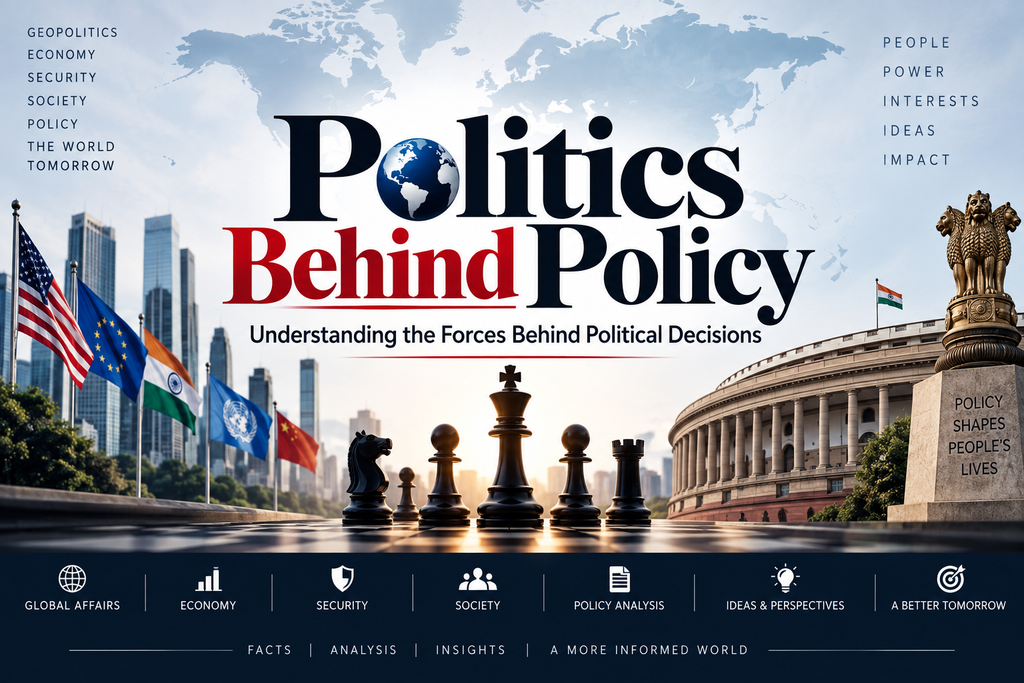
Introduction
Politics affects almost every part of our daily lives. From education and employment to taxation, infrastructure, technology and international relations, government decisions shape the opportunities and challenges faced by society.
But political news often focuses only on what happened. A government announced a new policy. Parliament passed a bill. Two countries signed an agreement. An election produced a particular result.
At Politics Behind Policy, we want to go one step further.
Our focus is on understanding what is behind these developments, why they matter and what their wider policy implications may be.
What Is Politics Behind Policy?
Politics and public policy are closely connected.
Political decisions can influence which issues receive attention, while public policies turn political priorities into programmes, laws and government actions.
For example, a decision related to education is not simply an education story. It may involve government spending, employment, social development, technology and long-term economic priorities.
Similarly, an international agreement can involve diplomacy, trade, national security, technology and strategic interests.
Understanding these connections helps readers see the bigger picture.
What We Will Cover
Politics Behind Policy will focus on five broad areas.
1. Indian Politics
We will cover important developments in Indian politics, including elections, Parliament, political parties, government decisions and major developments at the national and state levels.
2. Public Policy & Governance
This section will examine government policies, laws, reforms, welfare programmes, governance and their potential impact on citizens.
3. International Affairs
The world is increasingly interconnected. Developments in one country can affect others through trade, diplomacy, security, technology and global institutions.
We will examine India’s relationship with other countries as well as major developments in global politics and geopolitics.
4. Economy & Development
Economic decisions are an important part of public policy.
We will cover subjects such as government budgets, economic reforms, employment, infrastructure, trade, investment and development.
5. Analysis & Research
This will be the core of Politics Behind Policy.
Along with news, we will publish explainers, background articles, policy analysis and research-based stories that help readers understand complicated issues in simple language.
Beyond the Headlines
A headline can tell us what happened. It does not always explain the complete story.
For example, when a government introduces a new policy, several questions naturally arise:
Why was the policy introduced?
What problem is it trying to address?
Who could be affected?
What could be its economic and social implications?
What are the arguments supporting or questioning the policy?
These are the questions that policy-focused journalism should explore.
Our Approach
Politics Behind Policy aims to provide information in a clear, balanced and accessible manner.
We will distinguish between facts, analysis and opinion and use credible sources wherever possible. When an issue is disputed, we will present the relevant positions and evidence rather than treating a political claim as an established fact.
Our objective is to help readers develop their own understanding of important issues.
Why This Matters
An informed society needs more than breaking news.
Readers need context, reliable information and the ability to understand how political decisions connect with economic, social and international developments.
That is the space Politics Behind Policy aims to occupy.
Looking Ahead
Politics Behind Policy is being created as a platform for readers who want to understand India and the world through the combined lens of politics, policy and research.
Understand the politics. Explore the policy. See the bigger picture.

About the Author: Deepak Srivastava
An author of World Affairs, International Relations, Global Politics, Public Policy and Current Events.