
Introduction
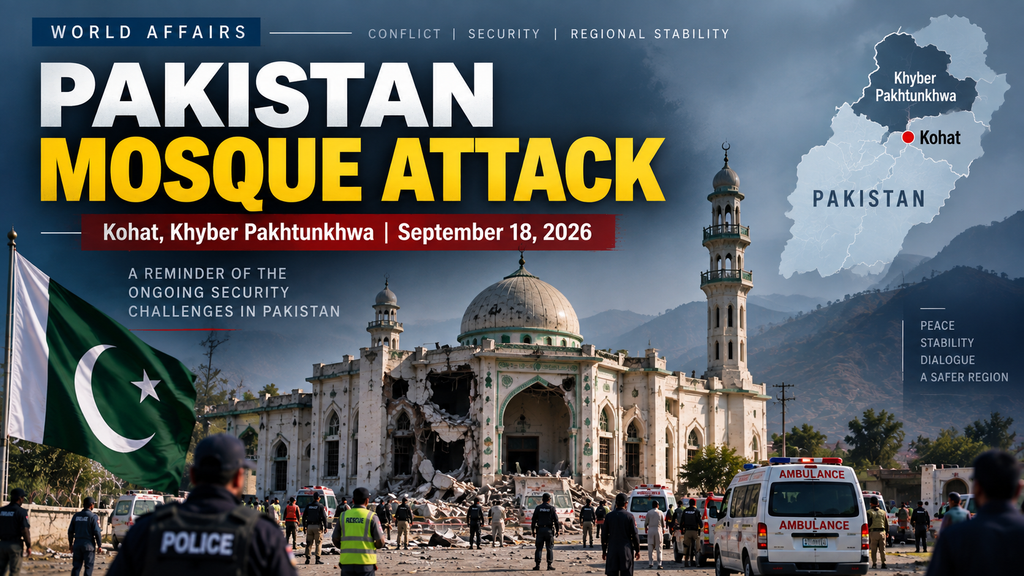
- On 18 September 2026, a deadly blast occurred at a mosque located near a police facility in Kohat, Khyber Pakhtunkhwa (KP), Pakistan, during Friday prayers.
- Early reports put the death toll at at least 16, with more than 50 people injured; later Pakistani reporting indicated the toll had risen to 21, showing that casualty figures were still developing. (AP News)
- The incident highlights Pakistan’s continuing challenges involving militancy, internal security and instability along its Afghanistan border.
What Happened?
- According to Pakistani officials cited by Reuters and AP:
- An explosives-laden vehicle struck the outer part of the police compound.
- The attack occurred while people were attending Friday prayers.
- Police officers and civilians were among the casualties.
- Armed attackers subsequently attempted to enter the compound, leading to a gunfight.
- No single attribution should be treated as established fact yet. Reuters reported that the Pakistani Taliban (TTP) denied involvement, while other reporting identified a TTP-linked faction as claiming responsibility.
Why Is the Attack Important?
1. Growing Militancy in Khyber Pakhtunkhwa
- KP has experienced repeated militant attacks in recent years.
- The province’s geographical location near Afghanistan makes it particularly important for Pakistan’s internal security.
- Attacks increasingly target security personnel, government facilities and civilians.
2. Pakistan–Afghanistan Security Concerns
- Pakistan has repeatedly accused militants of operating from Afghan territory.
- Afghanistan’s Taliban government has rejected such accusations.
- The issue has therefore become a major source of tension between Islamabad and Kabul.
3. Impact on Internal Security
- Repeated attacks can:
- Increase public insecurity.
- Put pressure on security forces.
- Divert government resources toward counterterrorism.
- Affect economic activity in vulnerable regions.
- The attack came shortly after a roadside bombing in nearby Hangu district that killed six soldiers, according to Pakistani authorities.
4. Religious Places and Civilian Safety
- The targeting of a mosque during Friday prayers has wider social consequences.
- Religious places are normally associated with community gathering and social cohesion.
- Violence against worshippers can deepen fear and communal tensions.
Regional Implications
- Afghanistan: Cross-border militancy could further strain Pakistan–Afghanistan relations.
- Central and South Asia: Persistent instability in the region can create wider security concerns.
- Counterterrorism: The incident underlines the need for intelligence-sharing and coordinated action against violent extremist networks.
- Humanitarian concerns: Continued violence can contribute to displacement and economic hardship.
Implications for India
- Border security: Instability in Pakistan’s western border region remains relevant to India’s wider security environment.
- Regional stability: Violence in South Asia can affect trade, connectivity and diplomatic cooperation.
- Terrorism: India has a strong interest in effective international cooperation against terrorism.
- Diplomacy: Regional security challenges reinforce the importance of multilateral counterterrorism mechanisms.
Way Forward
- Strengthen intelligence coordination to prevent attacks.
- Improve border management while maintaining legitimate cross-border movement.
- Address radicalisation through education, community engagement and rule of law.
- Strengthen regional cooperation against terrorist financing and recruitment.
- Promote Pakistan–Afghanistan dialogue to address disputes over militant activity.
- Protect civilians and religious institutions through appropriate security and emergency-response measures.
Conclusion
- The Kohat mosque attack is not only a tragedy for the victims and their families but also a reminder of the persistent security challenges facing Pakistan.
- For South Asia, sustainable peace requires more than security operations alone.
- Effective governance, regional dialogue, intelligence cooperation, economic development and respect for civilian life are essential for reducing the conditions that allow violent extremism to persist.

About the Author: Deepak Srivastava
An author of World Affairs, International Relations, Global Politics, Public Policy and Current Events.