
Why in News?
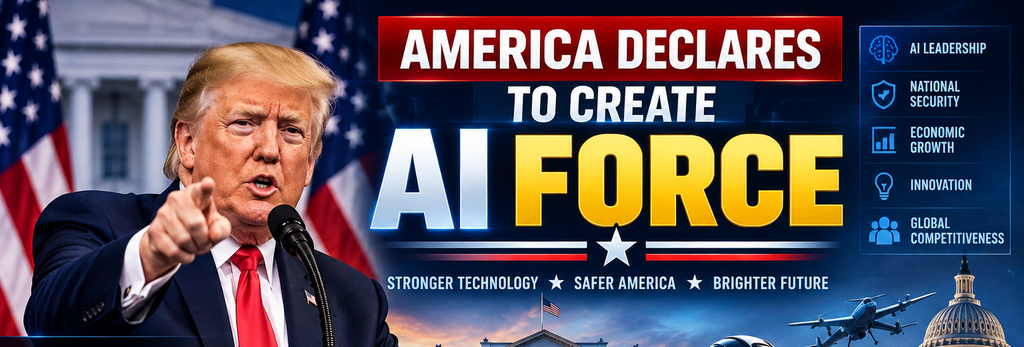
Artificial Intelligence (AI) is no longer limited to computers, technology companies and research laboratories. It is becoming an important part of a country’s economy, national security, jobs and future development. On September 19, 2026, U.S. President Donald Trump announced plans to create an “AI Force” and appoint an “AI czar” to oversee AI-related work. However, the exact structure, powers and responsibilities of the proposed force are yet to be clearly explained.
What is the Proposed AI Force?
The proposal comes at a time when the United States and China are competing strongly in advanced artificial intelligence. AI is now being used and developed across many important areas, including economic growth, scientific research, cybersecurity, national security, defence and strategic technologies. Trump has announced plans to create an AI Force to give artificial intelligence a greater role in the United States. He has compared the proposed force with the Space Force, but it is still unclear whether the new organisation would be a civilian agency, a military body or another type of federal institution. This development shows that AI is no longer being seen simply as a new technology. Countries increasingly view it as an important part of their economic strength, security and global competitiveness.
India’s Approach to AI
India is taking a different approach to artificial intelligence. Instead of creating an organisation called an “AI Force,” India is working to strengthen its AI ecosystem through the IndiaAI Mission. The mission focuses on improving access to computing infrastructure, developing quality datasets, supporting indigenous AI models, building AI-related skills and encouraging startups and innovation. It also places importance on the safe and responsible use of artificial intelligence. India is also promoting the idea of “AI for All.” The aim is to make the benefits of AI available to ordinary people and different sections of society. AI can play an important role in areas such as healthcare, agriculture, education and public services. The larger goal is to ensure that technological development is not limited to big companies and major cities but also reaches people in everyday life.
Significance for India
The growing U.S. focus on AI can create both opportunities and challenges for India. India has a large pool of IT professionals, a growing startup ecosystem and strong experience in digital technology. As global demand for AI services increases, Indian companies and skilled professionals could find new opportunities. The development could also create greater scope for India-U.S. cooperation in areas such as AI research, semiconductors, cybersecurity and responsible technology. At the same time, India will need to strengthen its own capabilities by investing in computing infrastructure, research, high-quality datasets and AI skills. Another important concern is employment. AI may change the way many people work and could create new types of jobs while reducing the need for some existing tasks. India will therefore need continuous skill development and better training opportunities to help its workforce adapt to these changes.
Along with economic opportunities, AI also brings concerns about privacy, misinformation, bias, accountability and misuse of technology. India will have to encourage innovation while also putting appropriate safeguards in place.
Conclusion
Trump’s proposed AI Force reflects the growing importance of artificial intelligence in global economic and strategic competition. For India, the focus should be on building strong domestic AI capabilities while continuing to cooperate with other countries. India has an opportunity to use AI to improve healthcare, agriculture, education, public services and economic growth. A balanced approach based on innovation, skills, inclusion, self-reliance and responsible governance can help India make the best use of AI while ensuring that its benefits reach ordinary people.

About the Author: Deepak Srivastava
An author of World Affairs, International Relations, Global Politics, Public Policy and Current Events.