
Imagine an American family sitting at the dinner table. The parents are worried about rising grocery bills, their children are thinking about education costs, and the family is struggling to find affordable housing. On television, politicians are promising to improve the economy, protect the country’s borders, and make life better for ordinary Americans.
The family has a simple question: Who is actually working for us? Millions of Americans face similar questions when they decide whom to support in an election. Their decisions may appear personal, but together they can change the direction of national politics. This is where the politics behind the US midterm elections begins. The 2026 US midterm elections are scheduled for November 3, 2026. Americans will vote for all 435 voting seats in the House of Representatives and the regularly scheduled Senate seats, along with many state and local offices. Unlike a presidential election, voters will not choose a new president. Donald Trump will remain president during the election. However, the results will influence how easily his administration can pass laws, secure funding and implement its policies. Behind this election lies a larger struggle involving political parties, wealthy donors, business groups, ordinary voters, media organisations and government institutions. Each stakeholder has different interests. Some want to protect the government’s existing policies. Others want to change them. Some are concerned about economic survival, while others focus on immigration, healthcare, national security or constitutional rights. To understand the midterm elections, we must look beyond campaign speeches and ask a deeper question: Who wants power, why do they want it, and how will that power affect ordinary Americans?
Structure of the US Congress
Why does this matter?
Imagine that the President wants Congress to pass a major tax bill. If the President’s party has sufficient support in both chambers, passing the bill may be easier. If the opposition controls one or both chambers, the proposal may face stronger resistance or require substantial changes. The President does not automatically lose office when the opposition wins congressional seats. Instead, the balance of political power changes. That is the real importance of the midterm elections: voters can change the legislative environment without changing the President.
1. Donald Trump: The President Whose Policies Are Under Scrutiny
Every midterm election is partly about the President’s performance. During a presidential campaign, candidates promise economic growth, stronger security, better public services and other improvements. Once in office, they must turn those promises into policies. By November 2026, voters will have had an opportunity to assess the direction of Donald Trump’s second administration. Supporters may defend his approach to immigration, taxation, trade, or national security. Critics may question the economic effects of his policies, their implementation or their impact on particular communities. Republican candidates must decide how closely to associate themselves with the President’s record. Some may strongly support his agenda, while others may place greater emphasis on local concerns or their own policy priorities.
Democratic candidates face a different challenge. They must explain why voters should support their candidates and how their proposed policies would address public concerns. However, the election is not simply a popularity contest between Trump and his opponents. Voters also evaluate individual congressional candidates, state-level issues and the quality of competing proposals. The political calculation is straightforward: Republicans will seek to defend their congressional position, while Democrats will seek opportunities to gain seats and influence national policy. The final outcome will depend on voters, candidates, local conditions and the distribution of competitive races.
2. The Two Major Parties: A Battle for Congressional Control
American politics is dominated by two major parties: the Republican Party and the Democratic Party. The Republican Party is the party of President Trump. Its candidates often emphasise border enforcement, tax policies, deregulation, national security and conservative social positions, although individual candidates differ. The Democratic Party includes a range of political views but commonly emphasises issues such as healthcare access, social protections, workers’ interests and civil rights. Its candidates also differ in their priorities and approaches.
Why are these parties fighting so hard for Congress? Because congressional control provides more than political prestige. The majority party can influence the legislative calendar, committee leadership and the consideration of bills. Committees investigate government activities, examine legislation, and conduct hearings. Congress also plays an important role in approving federal spending and scrutinising executive decisions.
If Republicans retain control of Congress, the administration may find it easier to advance parts of its legislative agenda, depending on party unity and the support required for particular measures. If Democrats gain control of one or both chambers, they may have greater influence over hearings, legislation, spending negotiations, and oversight. This is why a relatively small number of competitive congressional races can attract enormous national attention. For both parties, the objective is not simply to win votes. It is to gain the institutional power needed to influence the country’s future policies.
3. Ordinary Voters: The People at the Centre of the Election
Political leaders may dominate television screens, but voters determine the outcome. Consider three hypothetical American voters. The first is a young worker struggling to pay rent. The second is a small-business owner concerned about taxes and operating costs. The third is a parent worried about healthcare expenses and the cost of education. All three may care about the same election, but they may judge candidates differently.
The worker may focus on wages, housing and employment. The business owner may examine taxation, access to credit and economic regulation. The parent may prioritise insurance costs, schools and family support. Other voters may care more about immigration, abortion policy, climate change, gun laws, public safety or foreign policy. These differences create the political map that parties must navigate. A candidate cannot rely only on national slogans. They must also understand the concerns of people living in their district or state.
Voter turnout matters as well. A party may have substantial public support but still struggle if its supporters do not register, participate, or cast ballots. At the same time, election outcomes cannot be understood through turnout alone. Candidate quality, district boundaries, campaign organisation and the distribution of votes also matter. The central point is that ordinary voters are not merely an audience watching political leaders compete. They are the people whose collective choices determine who receives public authority.
4. The Economy: When Household Bills Become Political Issues
For many voters, politics becomes real when they open a bill, visit a supermarket or look for a house. National economic figures may show growth, but households can still struggle with rent, healthcare costs, food prices, or debt payments. This creates a challenge for the party in power. Voters may ask whether government policies are improving their daily lives. During the midterm campaign, candidates may discuss inflation, wages, employment, housing affordability, taxes, energy prices and government spending.
Republican candidates may defend their economic policies or argue that lower taxes and reduced regulation can encourage growth. Democratic candidates may emphasise affordability measures, worker protections or public investment. These are broad tendencies rather than fixed positions. Individual candidates may support different combinations of policies. There is another important factor: the President does not control the entire economy. The Federal Reserve makes monetary policy independently of the President’s direct control. International conflicts, global energy markets, technological changes and decisions by private businesses can also influence economic conditions.
Nevertheless, voters often hold the administration responsible for the economic direction of the country. This makes affordability a political issue as well as an economic one. When people believe that their financial situation is deteriorating, they may demand a change in leadership or policy. When they believe conditions are improving, they may be more willing to support the government’s record.
5. Immigration: Security, Jobs and Human Rights
Immigration is one of the most politically sensitive subjects in American elections. For some voters, the main concern is border security and whether the government is enforcing immigration laws effectively. Others focus on the treatment of migrants, legal immigration pathways, labour shortages and the contribution of immigrants to American society. Republican candidates frequently emphasise stronger enforcement and tighter border controls. Democratic candidates often place greater emphasis on legal pathways, humanitarian protections and changes to the immigration system, although their proposals vary.
These disagreements reflect different ideas about the responsibilities of government. One side may argue that a country needs effective border management to maintain public confidence in its immigration system. Critics of particular enforcement policies may raise concerns about due process, family welfare, and humanitarian obligations. The issue also has economic consequences. Employers in some sectors depend on immigrant labour, while communities must consider the effects of population changes on housing and public services.
Candidates must therefore address several questions at once: How should the country manage its borders? What rights should migrants receive? How should legal immigration work? What are the economic consequences of different policies? Immigration is not just a campaign slogan. It involves law, economics, public administration, and human lives. That is why it can become a major point of disagreement between candidates seeking the support of the same electorate.
6. Wealthy Donors and Business Groups: Who Pays for the Campaign?
Running a major congressional campaign requires money. Candidates need staff, offices, advertisements, research, travel, digital communication, and voter outreach. These activities cost money, so fundraising becomes an important part of electoral politics. Individual donors, political parties, political action committees and other organisations can provide financial support, subject to applicable laws.
Businesses and industry groups may also seek to influence political debates by supporting candidates, communicating with lawmakers or campaigning around particular policies. For example, energy companies may care about environmental regulations and drilling policy. Healthcare organisations may focus on insurance rules and government reimbursement. Technology companies may be concerned about competition policy, privacy and artificial intelligence regulation. Their interests do not always align, and organisations within the same industry may disagree.
The central question is whether the political system gives well-funded interests greater access and influence than ordinary citizens. Campaign spending can help a candidate communicate with voters, but money alone does not guarantee victory. Candidates must still persuade voters and build effective local campaigns. Campaign finance also has legal limits and disclosure requirements, although the rules differ according to the type of contribution or expenditure. For citizens, transparency matters because it helps them understand who is supporting a campaign and which policy interests may be involved. The politics behind campaign finance is ultimately about the relationship between money, access, and public decision-making.
7. Interest Groups and Lobbyists: Politics Beyond Election Day
Political influence does not end when voting ends. Interest groups work to shape laws, regulations and government decisions throughout the political process. Some represent business sectors. Others represent labour unions, environmental organisations, civil rights groups, professional associations, religious communities or particular policy causes. They may publish research, organise public campaigns, meet lawmakers, provide testimony at congressional hearings or ask supporters to contact elected representatives.
Consider a proposed change to healthcare policy. Patient organisations may argue that the proposal affects access to treatment. Insurers may focus on costs and regulation. Medical associations may raise concerns about healthcare delivery. Taxpayer groups may question the public expense. Lawmakers must evaluate these competing arguments while considering evidence, legal requirements and the interests of their constituents. Interest groups can provide useful information and help citizens organise around shared concerns. However, they can also create concerns when some groups possess far greater resources or access than others.
The important distinction is between participating in public debate and exercising influence without adequate transparency. Midterm elections matter to interest groups because the people elected to Congress will help shape future legislation and oversight. For these organisations, supporting a candidate may be one part of a longer effort to influence policy.
8. Media and Social Media: Who Shapes the Election Story?
US Modern elections are fought not only through speeches and advertisements but also through information. Television channels, newspapers, websites, podcasts, and social media platforms influence how citizens understand political events. A candidate’s statement can become a national story within minutes. A debate over healthcare or immigration can spread across social media, attracting both serious analysis and misleading claims.
Campaigns use digital platforms to communicate directly with supporters, raise money, and explain their positions. They may also use targeted advertising to reach particular groups of voters. However, fast communication creates risks. A misleading video, an inaccurate statistic or a false election claim can spread before reliable information becomes widely available. Political polarisation can make the problem worse. People may trust sources that support their existing views and dismiss information that challenges them.
Media organisations also face their own responsibilities. Election reporting should distinguish verified facts from campaign claims, explain the context behind statistics, and correct mistakes when they occur. Readers should compare reliable sources and check original documents when possible. For a political news website such as Politics Behind Policy, this is an opportunity to provide value through clear explanations rather than sensational headlines. The most useful election coverage does not simply tell readers who is criticising whom. It explains what a policy would do, who would be affected, and what evidence supports the competing arguments.
09. State Governments and Local Issues: Why Geography Matters
The United States is a federal country. Power is divided between the federal government and individual states. This means that elections in different states can involve very different concerns. Some communities may focus on agriculture, energy production, or industrial employment. Others may be more concerned about housing, transport, immigration, or access to public services.
State governments also influence election administration, subject to federal constitutional and legal requirements. Many state and local offices appear on the ballot during midterm elections. These contests can shape decisions about schools, policing, taxation, infrastructure and other local matters. Congressional elections also depend on the boundaries of House districts. A party may have strong support across a state but struggle to win a particular district, depending on how voters are distributed.
This makes geography an important part of electoral politics. National parties must balance broad political messages with the concerns of individual constituencies. A message that attracts voters in one region may be less effective elsewhere. For this reason, understanding the US midterms requires attention to state-level politics rather than treating the entire country as one uniform electorate.
10. Gerrymandering: Who Draws the Electoral Map?
Before voters choose their representatives, someone must determine the boundaries of congressional districts. This process can influence political competition. Gerrymandering occurs when electoral boundaries are manipulated to give a political party or group an unfair advantage. Because House seats are contested in individual districts, the way voters are grouped can affect which candidates have a realistic chance of winning.
District boundaries are generally determined through state-level processes, with different rules and safeguards across the country. When boundaries are drawn primarily for partisan advantage, the result may reduce competition and weaken the connection between the overall vote and the distribution of seats. This creates a difficult democratic question: should politicians have significant influence over the boundaries that help determine their own electoral prospects? Reforms such as independent redistricting commissions and more transparent mapping procedures aim to reduce partisan manipulation, although their design and effectiveness vary. The issue illustrates an important point: election politics begins long before election day. The rules governing representation can shape the contest itself.
11. Political Polarisation: Why Compromise Has Become Difficult
Imagine two lawmakers who represent different parties. Both face pressure from their supporters to defend their political positions. If either politician compromises, opponents within their own party may accuse them of abandoning their principles. This can make cooperation difficult even when both sides recognise that a problem needs attention. Political polarisation is a challenge because it can turn policy disagreements into conflicts over identity, loyalty and trust. Congressional disputes may involve taxation, immigration, healthcare, climate policy, judicial appointments and federal spending. When the parties disagree sharply, legislation may be delayed. Disputes over government funding can create uncertainty, and investigations may become politically contentious. However, disagreement is not automatically harmful. A legislature should debate proposals, question government decisions, and represent different views.
The problem arises when political competition prevents institutions from performing their basic responsibilities. Democracy does not require every party to agree. It requires political actors to respect constitutional rules and remain capable of negotiating when public interests demand it. The midterm elections may change the balance of power, but they cannot by themselves solve the deeper problem of political distrust.
12. Foreign Policy: How Domestic Politics Shapes America’s Role in the World
American elections also matter beyond the country’s borders. The United States plays an important role in international security, global trade, financial institutions, and diplomatic negotiations. Congress influences foreign policy through legislation, funding, oversight and its constitutional responsibilities. The Senate also has a role in treaty ratification and the confirmation of many presidential nominees. This means that congressional control can affect debates over defence spending, international assistance, trade measures and relations with other countries.
For example, lawmakers may disagree over military support for allies, economic competition with China, international agreements or the use of sanctions. Foreign policy can also affect domestic politics. International conflicts may influence energy prices, trade, government spending and national security concerns.
Nevertheless, a change in congressional control does not automatically reverse the President’s foreign policy. The effect depends on the issue, the legal powers involved, and the political circumstances. The wider lesson is that domestic elections can influence international relations because decisions made in Washington often have consequences around the world.
13. What Happens If Congress Changes Hands?
One of the most important questions in a midterm election is what happens if the opposition gains control of a congressional chamber. If the President’s party retains control of both chambers, it may have a clearer path to advancing its legislative agenda, although disagreements within the party can still create obstacles. If the opposition wins the House, it can gain greater influence over legislation, committee leadership, investigations and government oversight. If the opposition wins the Senate, it can influence the consideration of legislation, presidential nominations and other matters governed by Senate rules and constitutional powers.
If control is divided, the administration may need to negotiate with opposing lawmakers more frequently. However, no outcome guarantees that every proposal will pass or fail. Legislative procedures, party unity, the size of majorities and the details of individual bills all matter. The President remains in office regardless of which party controls Congress. This is the central feature of the American system: voters can change the balance of legislative power without directly changing the executive leadership.
14. Why the 2026 US Midterm Matters for American Democracy
The 2026 midterms are important because they give citizens an opportunity to evaluate political leadership and influence the direction of public policy. They also test whether political institutions can manage disagreement through constitutional procedures. For the administration, the elections will provide evidence of how voters view its policies and congressional candidates associated with its agenda. For the opposition, the elections offer an opportunity to gain representation, scrutinise the government and present alternative approaches.
For businesses and interest groups, the outcome may influence the future policy environment. For ordinary citizens, the stakes include the laws, spending decisions and government priorities that affect their daily lives. For international partners, the results may provide clues about the political constraints facing the American administration, although they will not determine every future foreign policy decision. Yet an election should not be judged only by which party wins more seats. Its democratic value also depends on whether citizens can participate freely, whether information is reliable, whether votes are counted lawfully, and whether elected representatives remain accountable.
Conclusion: Behind Every Vote Is a Struggle Over Power and Policy
Return to the American family sitting around the dinner table. The parents are still thinking about household expenses. Their children are still concerned about education and future employment. Across the country, other families are discussing immigration, healthcare, taxes, security and the direction of the economy. Meanwhile, political parties are raising money, candidates are campaigning, interest groups are defending their priorities, and media organisations are explaining or debating the issues.
All these activities come together in the midterm elections. The Republican Party wants to defend its political position and support its preferred policies. The Democratic Party wants to win representation and influence the national agenda. Donors and interest groups seek to shape the policy environment. Media organisations influence public understanding. State governments administer important parts of the electoral process. Above all, voters decide whom to elect.
No single stakeholder controls the entire process. Their influence depends on the law, political circumstances, public opinion and the decisions citizens make. The 2026 US midterm elections are therefore about more than a contest between two parties. They are about who will shape legislation, how government power will be scrutinised and which public concerns will receive attention. The real politics behind the US midterm elections lies in the struggle to turn public opinion into political power. The final question is not simply who wins Congress, but how that victory changes the lives of the people who sent their representatives there.
FAQs of US Midterm Elections 2026
1. What Are the US Midterm Elections 2026?
The US midterm elections are federal elections held halfway through a president’s four-year term. They allow voters to elect members of Congress and influence the balance of political power in Washington. Unlike presidential elections, voters do not choose the president during midterms. Instead, they elect representatives and senators who make laws, approve spending, and oversee the federal government. The results can affect the president’s ability to implement policies.
2. When Will the US Midterm Elections 2026 Take Place?
The US Midterm Elections 2026 are scheduled for Tuesday, November 3, 2026. Americans will vote for congressional representatives and senators in their respective states. Some states will also hold gubernatorial and other state or local elections. Primary elections take place earlier in the year to select party candidates. Voting procedures and registration deadlines vary by state, so citizens should consult their official state election offices for accurate information.
3. Why Are the US Midterm Elections 2026 Important?
The elections are important because they determine which political parties control the House of Representatives and the Senate. Congressional control influences legislation, federal spending, investigations, and government oversight. The results may also affect President Donald Trump’s policy agenda. If the president’s party loses control of a chamber, passing legislation can become more difficult. The elections also provide voters with an opportunity to express their views on government performance and national priorities.
4. How Many House Seats Are Contested in US Midterm 2026?
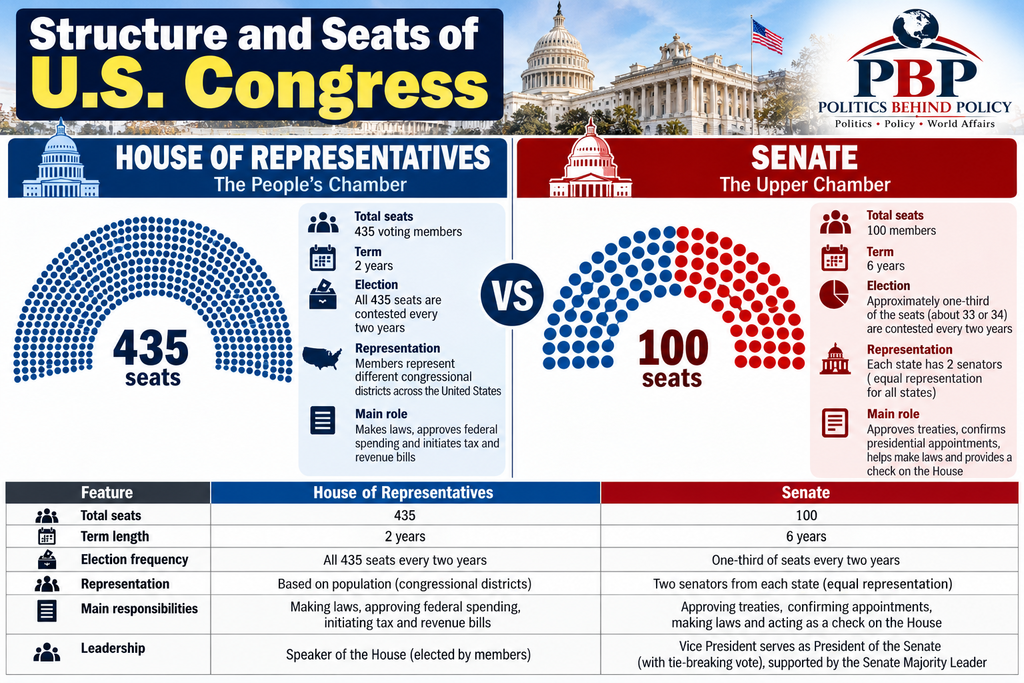
All 435 voting seats in the US House of Representatives are scheduled for election in 2026. Representatives serve two-year terms and represent congressional districts across the country. The number of representatives assigned to each state depends on its population. House elections can influence decisions about taxation, federal spending, healthcare, education, and immigration. Winning a majority of seats gives a political party greater control over the chamber’s leadership, committees, and legislative agenda.
5. How Many Senate Seats Are Contested in US Midterm 2026?
Thirty-five Senate seats are scheduled for election in 2026, including regularly scheduled elections and special elections. The Senate has 100 members, with two senators representing each state. Senators serve six-year terms, and elections are staggered so that approximately one-third of the chamber faces voters every two years. Senate results matter because senators consider legislation, confirm many presidential appointments, and vote on treaties. The outcome can influence the direction of national policy and government oversight.
6. What Is the Difference Between the House and the Senate?
The House of Representatives has 435 voting members who serve two-year terms. The Senate has 100 members who serve six-year terms. House members represent individual congressional districts, while each senator represents an entire state. Both chambers participate in federal lawmaking, but they have different constitutional responsibilities. Revenue bills originate in the House, while the Senate has a special role in confirming appointments and ratifying treaties. Most legislation must pass both chambers before reaching the president.
7. Who Can Vote in the US Midterm Elections?
Generally, US citizens aged 18 or older can vote if they meet their state’s registration and eligibility requirements. Noncitizens cannot vote in federal elections. Some states permit eligible voters to register on Election Day, while others require registration beforehand. Citizens should check their registration status, polling location, identification requirements, and voting deadlines through official election authorities. These steps help voters understand the rules that apply in their state and participate in the electoral process.
8. What Are the Main Issues in the 2026 US Midterm Elections?
Major issues include the economy, inflation, employment, healthcare, immigration, taxation, and foreign policy. Voters may also consider education, housing affordability, energy prices, and access to public services. The importance of each issue varies by state, district, and individual voter. Candidates often present different approaches to these challenges. Understanding their policy proposals, voting records, and public statements helps citizens compare the available choices and evaluate how congressional decisions could affect their communities.
9. How Can the Midterms Affect President Donald Trump?
The midterms can influence the president’s ability to advance his legislative priorities. Congress controls the passage of federal laws and plays a central role in approving government spending. If the president’s party maintains congressional majorities, advancing some proposals may be easier. If the opposition gains control of a chamber, negotiations and legislative disagreements may increase. Congress also conducts oversight of the executive branch. However, election results do not automatically remove a president from office or change the presidential term.
10. What Is the Role of the US House of Representatives?
The House of Representatives represents citizens through congressional districts and participates in creating federal laws. It has 435 voting members, with representation allocated among states according to population. The House initiates revenue legislation and plays a major role in federal spending decisions. It can also conduct investigations and exercise oversight of government agencies. Additionally, the House has the constitutional power to impeach federal officials, including the president. Its membership therefore has a significant influence on national governance.
11. What Is the Role of the US Senate?
The Senate represents all 50 states equally, with two senators per state. Its responsibilities include considering legislation, confirming many presidential appointments, and providing advice and consent on treaties. The Senate also conducts oversight and can hold impeachment trials after the House approves articles of impeachment. Because senators serve six-year terms, their elections follow a different schedule from House elections. The 2026 Senate contests could influence committee leadership, judicial confirmations, legislative negotiations, and other important federal decisions.
12. What Is a Swing State or Competitive Election District?
A swing state is a state where support for major political parties is relatively competitive. In congressional elections, analysts also use the term competitive district to describe a race that either party has a realistic opportunity to win. Campaigns may devote substantial attention and resources to these contests. However, competitiveness can change because of candidate selection, local issues, turnout, and political developments. A competitive race does not guarantee a particular outcome, and every eligible vote remains part of the democratic process.
13. What Is Voter Turnout, and Why Does It Matter?
Voter turnout measures how many eligible or registered voters participate in an election, depending on the method used to calculate it. Turnout affects how fully election results reflect the participating electorate. Participation can vary by age, location, election type, and public interest in political issues. Midterm elections sometimes attract less attention than presidential elections, although turnout varies considerably between election cycles. Registration, access to voting information, and awareness of local issues can influence participation.
14. What Is Early Voting in the United States?
Early voting allows eligible citizens to cast their ballots before Election Day. The available dates, locations, and procedures depend on state law. Some states offer in-person early voting, while others provide different voting arrangements. Early voting can help people manage work schedules, family responsibilities, travel, or other commitments. Voters should verify opening dates, identification rules, and polling locations through official state election websites. They should also ensure they follow the applicable rules when submitting their ballots.
15. What Is Absentee or Mail-In Voting?
Absentee and mail-in voting allow eligible voters to cast ballots without voting in person at a polling place on Election Day. Rules differ across states regarding eligibility, ballot requests, delivery methods, deadlines, and signature requirements. Some states routinely send ballots to registered voters, while others require voters to request them. Citizens should obtain instructions from their official election office and return completed ballots before the relevant deadline. Following state procedures helps ensure ballots can be processed correctly.
16. How Do Primary Elections Work Before the Midterms?
Primary elections help political parties select candidates for the general election. Depending on state law, voters may participate in open, closed, or other types of primary elections. Candidates compete for their party’s nomination, and the winner generally advances to the general election. Some states also use caucuses or other selection procedures. Primary dates differ across the country, so candidates may be selected at different times. Understanding primary rules helps voters learn who will appear on their November ballot.
17. How Can US Midterm Election Results Affect Healthcare and the Economy?
Congressional decisions can influence healthcare funding, insurance regulations, taxation, employment programmes, and federal spending. The effects depend on the legislation passed, the administration’s implementation, and economic conditions. Different lawmakers may propose different approaches to healthcare access, business regulation, public benefits, and deficit reduction. Midterm results can change which proposals receive attention or support in Congress. However, election outcomes alone do not determine economic performance, because global conditions, private-sector activity, and other factors also matter.
18. When Will the US Midterm Election Results Be Announced?
Election results are reported as state and local authorities count ballots and publish updates. Some races may be called on Election Night, while others may take longer because of close margins, outstanding ballots, recount procedures, or state certification requirements. Media organisations may project winners, but projections are not the same as official certification. Voters should consult official election authorities for certified results. The timing of final results varies by race and state, so an immediate nationwide final count should not be assumed.
19. Can the 2026 US Midterms Change US Foreign Policy?
The elections can influence foreign policy indirectly by changing congressional leadership, committee priorities, funding decisions, and support for legislation. Congress plays important roles in defence spending, foreign assistance, sanctions legislation, and oversight of international affairs. The president and executive branch also exercise substantial foreign policy authority within constitutional and legal limits. A change in congressional control may alter debate or legislative support, but it does not automatically produce a complete change in US foreign policy. Specific outcomes depend on decisions made after the elections.
20. Why Should Americans Follow the US Midterm Elections 2026?
Americans should follow the elections because congressional decisions affect laws, public spending, taxation, government oversight, and national priorities. Understanding the candidates and their policy positions helps voters make informed choices. Election coverage also provides insight into public concerns and political participation across different states and communities. Citizens can follow official election information, examine reliable reporting, and compare candidates’ documented records. The midterms offer an important opportunity for democratic participation and help determine the composition of Congress for the next legislative term.

About the Author: Deepak Srivastava
An author of World Affairs, International Relations, Global Politics, Public Policy and Current Events.